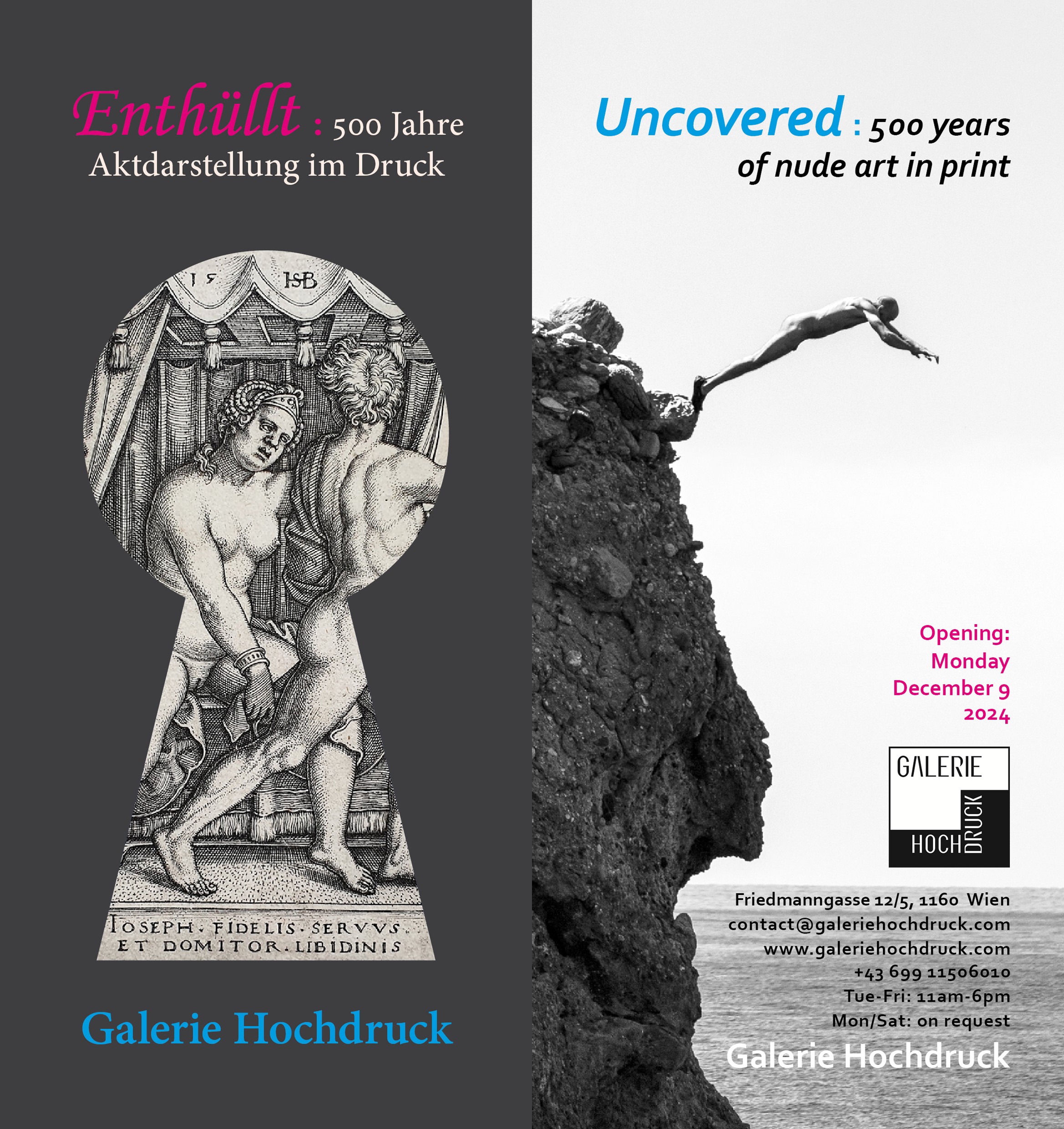
The nude, the representation of the naked human body, began
its existence as a ritual object in the form of pictures and sculptures, while its German name 'Akt' originally referred to
the study of the body in motion. Today, the classic artistic nude is increasingly perverted through the immeasurable flood
of pornographic images.
This has led to a new kind of prudery, in which even the slightest
interest in nudes, however artistically or historical significant they may be, becomes suspicious. Facebook and Instagram
have set the standard for this new prudery, going as far as classifying the Venus of Willendorf as pornographic. In between
there were the well-known nude art scandals of the nineteenth century involving artists such as Manet, Goya, and Courbet.
They dwindle into insignificance, of course, compared with everything that is generally expected of and tolerated today in
mainstream cinema and theatre. In fact, the real and much less showy platform for the classical nude is drawing, from rapid
sketches to detailed studies, on their own or as preparation for a larger work in another medium. Although we are talking
about drawings here, prints are related to them to a certain extent. Either preparatory drafts are made during the production
process as was the case with Käthe Kollwitz's woodcuts, or the drawing is applied directly to the printing matrix, as with
etchings or lithographs. The German Expressionists even carved the image with a knife directly onto the woodblock. Unlike
some studies drawn on paper, prints – not mechanically reproduced images – are always to be understood as stand-alone works
of art, since they are rarely intended for transfer to another medium. Photography is a special case. Although chemical analogue
photography is not a print-making technique, a survey of the history of nude pictures would not be complete without consideration
of this medium, not least as it was used from early on to provide artists with nude models. Moreover, for large print runs,
photographs had often to be converted into a stable printable medium, such as photogravure, collotype, relief halftone, rotogravure
or the more recent giclée print, not to mention the many possibilities for using photographic templates in screen printing
or other printable media. The exhibition at Galerie Hochdruck brings together printed and drawn nudes over a period of five
hundred years – from Dürer's ironic and probably autobiographical
Men's Bath House (c. 1497) and mythological or
Old Testament depictions such as Hans Sebald Beham's
Joseph and Potiphar's Wife (1544), whose small format inevitably
brings to mind historical carte-de-visite nude photos, to the vulnerability of the human body in Käthe Kollwitz's disturbing
depictions, Anton Kolig's hastily drawn male torsos, and the humorous (self-)portraits by Kia Sciarrone, a photographer and
the youngest participant in the exhibition.
More
information